
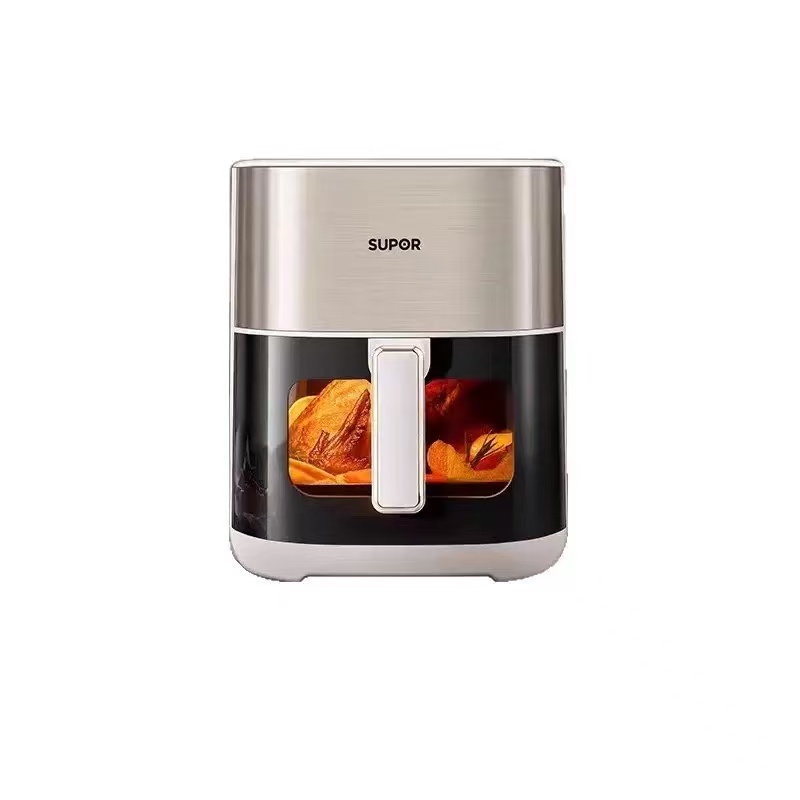
Air fryers have become a popular small appliance in modern kitchens due to their health benefits, oil-free operation, and ease of use. However, consumers often struggle to choose between all-in-one and separate models. The core difference lies in the connection between the main unit and the frying basket, and they are suited to different usage scenarios and needs. There is no absolute superiority or inferiority; the key is to match your cooking habits, family size, and cleaning needs. Below is a detailed comparison from several key dimensions to help you choose the right type.Differences Between Mechanical and Electronic Air Fryers
In terms of user experience and ease of operation, each has its own emphasis. All-in-one air fryers often feature a drawer-style design, with the main unit and frying basket integrated. To operate, simply place the food in the basket and push it in to start. The overall structure is compact and takes up little space, making it ideal for small apartments or studios with limited kitchen space. The control panel is usually integrated at the front of the unit, with clear buttons and a wealth of preset menus, making it easy for cooking novices to use. However, the frying basket of an all-in-one model needs to be pulled out as a whole, which may be a bit cumbersome for users with less strength when full of food.How to Choose Your First Air Fryer?
Detachable air fryers feature a separate basket design, allowing for easy loading and unloading of food by simply lifting the basket. Some high-end models even employ a double-layer structure with a separate basket and oil filter, where the upper layer is perforated for frying and the lower layer catches the grease, improving oil separation efficiency by 50% and better meeting healthier eating needs. This design is particularly suitable for scenarios requiring frequent food additions or mid-process checks, avoiding the inconvenience of a single-piece design with a pull-out drawer. However, detachable designs typically require more space for placement, and the basket needs precise alignment to start, demanding a certain level of flatness.How to choose the power rating for an air fryer?
Cleaning difficulty is the most significant difference between the two types and a key concern for users. The connection between the basket and body in a single-piece air fryer easily traps dirt and grime, and in some models, the basket is close to the heating element, making it difficult to clean grease from the crevices. Even with a non-stick coating, careful wiping is necessary. However, most single-piece baskets can be completely disassembled for rinsing in a sink, and some are dishwasher compatible, reducing cleaning effort to some extent.
Detachable air fryers have a clear advantage in cleaning. Since the frying basket is completely separate from the body, it can be immersed entirely in water for cleaning, eliminating any hard-to-reach areas. Combined with a food-grade non-stick coating, grease residue can be reduced by 70%, and cleaning typically takes no more than 5 minutes, making it especially user-friendly for frequent cooks who dislike cleaning. Some models also have a removable oil filter rack, allowing for focused cleaning of stubborn grease, further improving cleaning efficiency.
In terms of cooking performance and durability, there is little difference between the two. One-piece air fryers offer better sealing and more stable hot air circulation, ensuring more even heating of food and preventing undercooked areas. Their robust structure makes them less prone to loosening or shifting over time, resulting in a generally longer lifespan. Detachable air fryers, once the frying basket is properly installed, can achieve a crispy exterior and tender interior thanks to their 360° three-dimensional hot air circulation technology. However, frequent disassembly and reassembly may cause wear at the joints, so the seal should be checked regularly over long-term use.
Comprehensive selection recommendations: For singles or couples with small kitchens, infrequent cooking, and a preference for simple operation, an all-in-one model is the best choice, saving space and being easy to use. For families with more members, more frequent cooking, and who prioritize cleaning efficiency, a separate model is a better option, especially models with a double-layer oil filter structure, which are both healthy and worry-free. Regardless of the type chosen, it is recommended to prioritize products with a food-grade non-stick coating and a removable, washable design, balancing health and practicality.