
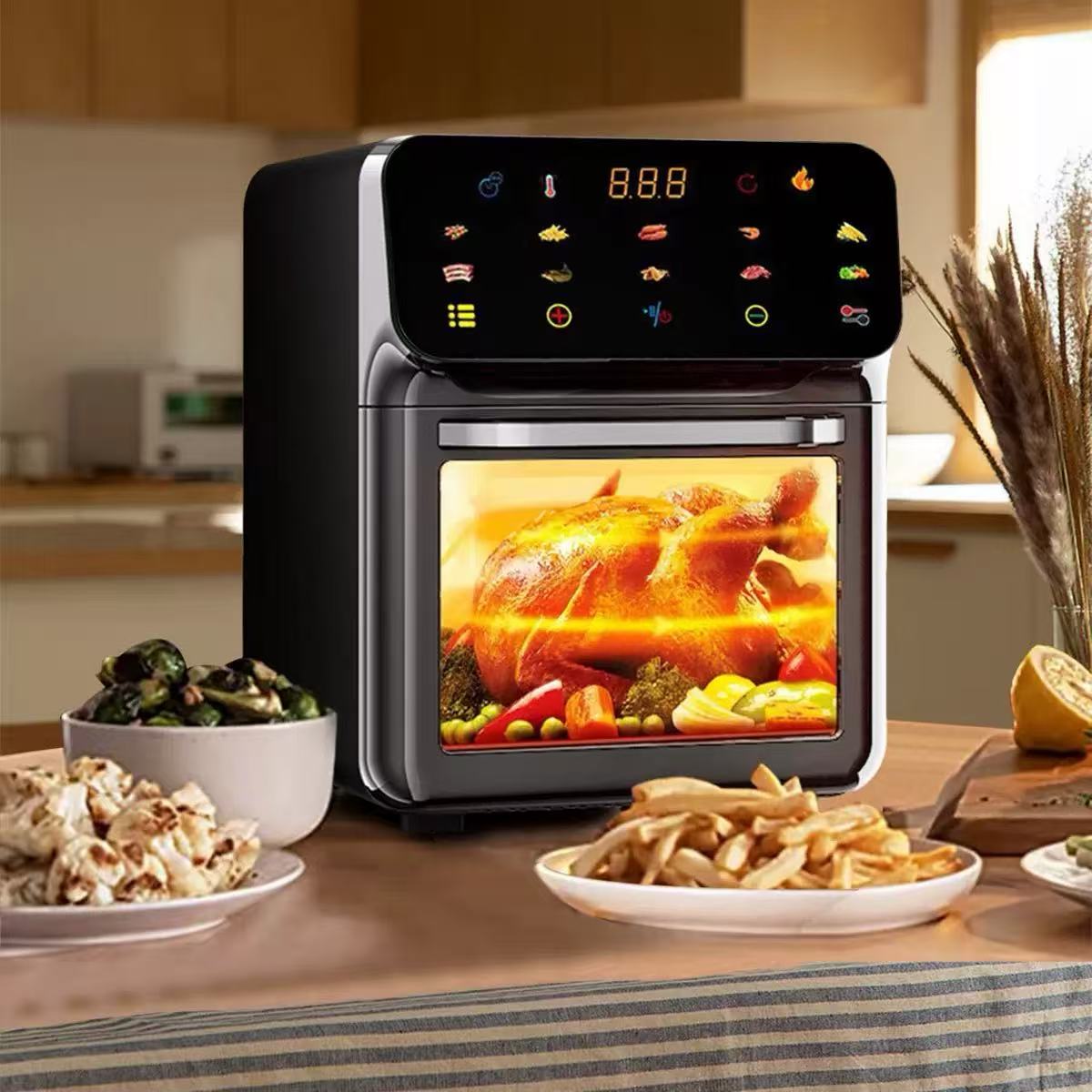
Air fryers and ovens are common baking and cooking appliances often compared by consumers. While both can perform basic functions like baking and roasting, air fryers, with their unique hot air circulation technology and compact design, offer advantages that ovens cannot match in many scenarios. Especially for small families, cooking novices, or those seeking an efficient and convenient lifestyle, air fryers can fulfill many cooking needs that ovens struggle to achieve. Below, we’ll break down the key differences in functionality, detailing what air fryers can do that ovens cannot, helping you clearly distinguish the applicable scenarios for each.Should I buy an air fryer with a viewing window?
Quickly achieving a “less oil, crispier” texture, balancing deliciousness and health, is the core unique advantage of air fryers. To achieve a crispy texture in an oven, it usually requires soaking the food in a lot of oil or relying on prolonged high-temperature baking to dehydrate the food, which is not only time-consuming but also easily leads to excessive oil intake. Air fryers utilize 360° high-speed hot air circulation technology, quickly removing surface moisture from food with hot air while using the food’s own oils to achieve a crispy outer layer. This eliminates the need for additional oil or requires only a small amount. For example, to make French fries, an air fryer can produce a crispy exterior and soft interior in just 15 minutes, requiring only a light spray of oil. In contrast, an oven requires marinating and oiling beforehand, and baking for over 30 minutes, resulting in a less crispy texture and significantly less oil usage.What’s the Best Price Range for an Air Fryer?
Small portions can be cooked precisely and quickly, avoiding waste. Ovens typically have a capacity of 20L or more, suitable for bulk cooking. However, for small meals of 1-2 people, ovens have significant limitations: firstly, preheating time is long (usually 15-20 minutes), resulting in high energy consumption for preheating and significant energy waste when cooking small portions; secondly, uneven heating within the oven can lead to uneven cooking, with some parts of the food being burnt while others are undercooked. Air fryers typically have a capacity of 3-5L, designed specifically for small-portion cooking. Preheating time is only 3-5 minutes, and some models even support preheating-free cooking, quickly preparing single-serving portions of roasted chicken wings, mini pizzas, and small portions of roasted vegetables. For example, making 1-2 loaves of toast in the morning can be done in 3 minutes with an air fryer, while an oven requires 10 minutes just to preheat, making it completely unsuitable for such immediate small-portion cooking needs.Which Air Fryer Basket Material is Best?
Low-temperature, rapid reheating restores the crispness of food, an advantage that ovens cannot match. Reheating food in an oven usually requires higher temperatures (above 180℃) and longer times, easily leading to excessive moisture loss, especially for fried and crispy foods (such as fried chicken, fried dough sticks, and biscuits), which become dry, hard, and unpalatable after reheating. Air fryers, on the other hand, offer a wide temperature range of 60-200℃, and during low-temperature reheating, they use gentle hot air circulation to evenly heat food while preventing excessive moisture evaporation. For example, reheating overnight fried chicken in an air fryer at 120℃ for 5 minutes will restore its crispy skin and tender interior; while reheating in an oven will result in tough, dry chicken with a lost crispness. Furthermore, when reheating small portions of leftovers, an air fryer can precisely control the heating range, unlike an oven where the large cavity causes rapid heat loss, making it more efficient.
It offers convenient, smokeless cooking, ideal for small, enclosed kitchens. Ovens produce a lot of smoke when baking fatty foods (such as pork belly or chicken wings) at high temperatures, requiring a powerful range hood; otherwise, the smoke will fill the entire kitchen, polluting the environment and difficult to clean. Air fryers, with their sealed design and high-speed hot air circulation, quickly remove smoke, which is then filtered through an internal filter, resulting in virtually no smoke during cooking. For small, enclosed kitchens with poor ventilation, air fryers are safe to use. Even when cooking high-fat foods like roasted pork belly, they won’t produce pungent fumes. Ovens, on the other hand, struggle with fumes in such environments and may overheat due to poor ventilation, posing a safety hazard.
Air fryers offer instant emergency cooking, perfect for fast-paced lifestyles. Modern urban dwellers often face the need for quick hot meals after a late day, and air fryers excel in this area compared to ovens. Air fryers are extremely easy to operate, requiring no complex temperature or time adjustments. Most models come with preset menus, allowing for one-button cooking. For example, a steak can be prepared in 10 minutes using the “steak” preset program, requiring no supervision. Ovens, however, require manual temperature and time settings and preheating, making the process cumbersome and taking at least 25 minutes from preparation to completion. Furthermore, air fryers are compact and can be placed directly on the countertop, eliminating the need for pre-packaging, making them even more convenient for emergency cooking – an advantage ovens cannot match.
In summary, air fryers offer unparalleled advantages over ovens in areas such as low-oil, crispy cooking, quick small-portion preparation, precise low-temperature reheating, smokeless operation, and immediate emergency cooking. They are not substitutes but complements: ovens are suitable for batch baking and large-scale food preparation, while air fryers are ideal for small-portion, quick, and healthy everyday cooking needs. Understanding the unique functions of an air fryer allows for a more precise match with your cooking habits, maximizing the value of your kitchen appliance.