
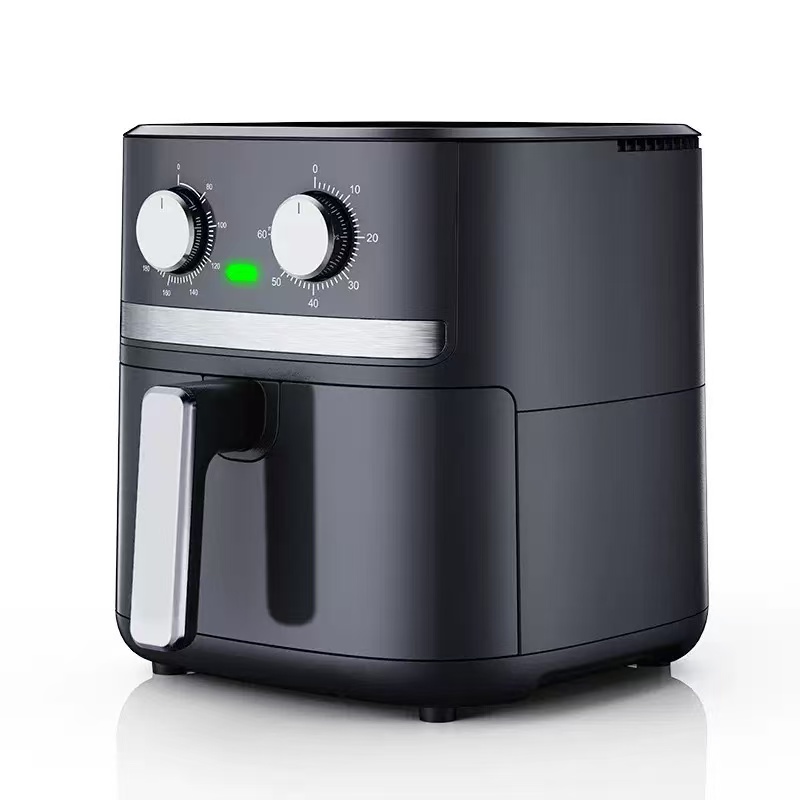
In modern kitchen appliances, both air fryers and ovens are popular baking tools, but air fryers, with their design that better meets the needs of convenient living, have become the first choice for many families, young people living alone, and those who work overtime. Compared to ovens, air fryers show significant advantages in terms of health benefits, cooking efficiency, ease of operation, and space adaptability, precisely addressing the core pain points of daily cooking: “fear of trouble, fear of greasiness, and limited space,” redefining a convenient and delicious way of cooking.How to Choose Your First Air Fryer?
The most prominent advantage of an air fryer is its healthier and lower oil content, which is also one of its core highlights that distinguishes it from an oven. It uses a top heating element combined with a high-speed fan to create 360° hot air circulation, utilizing the food’s own oil to quickly heat and dehydrate it, producing a crispy texture without the need for additional oil. It uses 80% less oil than traditional frying and actively removes excess oil from the food. Real-world testing data shows that chicken wings cooked in an air fryer can remove 20% of the oil, and the acrylamide (a Group 2A carcinogen) produced is only half that of frying. The loss rate of vitamin B1 is also much lower than with traditional frying, making it more in line with healthy eating principles. When baking or frying food in an oven, extra oil is usually needed to achieve a crispy texture, making it difficult to control oil intake.How to choose the power rating for an air fryer?
In terms of cooking efficiency and ease of use, air fryers far surpass ovens. Air fryers use a closed, small-space design, resulting in more efficient hot air circulation. They require no preheating and reduce cooking time by more than 40% compared to ovens. For example, to make 300 grams of frozen fries, an air fryer takes only 16 minutes, while an oven (including 10-15 minutes of preheating) takes 32 minutes; roasting chicken wings takes only 15 minutes in an air fryer, while an oven takes more than 25 minutes. Furthermore, air fryers are extremely easy to operate, mostly using knobs or simple touch controls with a wealth of preset menus, allowing even beginners to use them with a single touch. Ovens, on the other hand, require mastering preheating time and adjusting top and bottom heat temperatures, making it easy for baking novices to fail. In addition, air fryers consume less energy per use; a 1500W air fryer consumes only 0.375 kWh for 15 minutes, far less than the 0.83 kWh consumed by a 2000W oven for 25 minutes.
For purchases, please add the following WhatsApp contact.
In terms of space adaptability and cleaning/maintenance, air fryers also have a significant advantage. Most air fryers have a capacity of 3-7L, are compact, and can be easily stored in cabinets without taking up fixed countertop space, making them especially suitable for small kitchens, renters, and studio apartments. Ovens, on the other hand, are larger and often require fixed placement, demanding more kitchen space. For cleaning, air fryer baskets are mostly removable, with Teflon or ceramic non-stick coatings on the inner walls, making grease easy to rinse off; using parchment paper can achieve zero-cleaning. Ovens, with their large internal space, are prone to grease splattering and adhesion, making cleaning more difficult, especially cleaning grease from multiple racks and crevices.
In conclusion, compared to ovens, air fryers better meet the cooking needs of modern fast-paced lifestyles. Their core advantages—healthy and low-oil cooking, time-saving and efficient, simple operation, space-saving, and easy cleaning—make them ideal for young people living alone, those who work long hours, small apartments, and health-conscious individuals. While ovens have advantages in baking expertise and large-capacity cooking, air fryers are undoubtedly a more practical choice for everyday cooking scenarios that prioritize convenience, deliciousness, and health. This is why they have become an essential appliance in the kitchens of more and more families.